SARS has introduced administrative penalties for outstanding trust income tax returns, including returns for trusts that haven't generated income. From 4 May 2026, penalties can apply to outstanding ITR12T returns for 2024 onwards.
At the same time, proposed changes to trust legislation point towards greater oversight, governance and transparency.
For trustees and founders, the message is fairly simple: trust compliance needs to be actively managed.
This guide explains what has changed, how trusts are taxed, what Section 7C means, what the new SARS penalties could cost, and what trustees should do now.
What is a Trust in South Africa?
Here are the key players:
The founder is the person who creates the trust and establishes the terms under which it will operate. The founder may contribute the initial assets to the trust and sets out the purpose and rules in the trust deed.
The trustees are responsible for managing the trust and its assets. They have fiduciary duties and must act in accordance with the trust deed and applicable legislation. Being a trustee isn't simply a matter of having your name on a document — it comes with real responsibilities.
The beneficiaries are the people, groups or organisations who are intended to benefit from the trust. Depending on the trust deed, beneficiaries may have fixed rights to income or capital, or trustees may have discretion over when and how benefits are distributed.
The trust deed is essentially the rulebook for the trust. It sets out who the trustees and beneficiaries are, what the trustees can and cannot do, how assets may be managed and distributed, and what happens in different circumstances. This is one document you don't want to treat as paperwork that gets filed away and forgotten.
The Master of the High Court has an important oversight role in relation to trusts. Trustees generally need to be authorised by the Master before they can act, and the Master's office maintains trust records and deals with matters such as trustee appointments and amendments.
SARS has a separate role. A trust can have income tax, capital gains tax, donations tax and other tax obligations, and trusts generally need to be registered with SARS and submit the relevant returns. Tax compliance is therefore a separate — but closely connected — responsibility to the trust's administration through the Master.
Trust property refers to the assets held by the trust. This could include cash, investments, property, shares or other assets. The trust deed and the way those assets are transferred and administered determine how the trust operates in practice.
Types of Trusts in South Africa
Not all trusts are structured the same. SARS recognises several different classifications, and a trust can fall into more than one category depending on how it was created, how the assets are held and what rights beneficiaries have.
The Main Types of Trusts
- Ownership trusts: The founder transfers ownership of assets to trustees, who hold them for the benefit of the beneficiaries.
- Bewind trusts: The beneficiaries own the assets, but the trustees are responsible for managing and controlling them.
- Inter vivos trusts: Created during a person's lifetime through an agreement between the founder and trustees.
- Testamentary trusts: Created through a will and come into effect after the founder's death.
- Vesting trusts: Beneficiaries have vested rights to income, capital gains or trust assets.
- Discretionary trusts: Trustees have discretion over which beneficiaries receive income, capital or assets, subject to the trust deed.
- Hybrid trusts: Combine elements of vested and discretionary trusts.
There are also trusts created for specific purposes, including business trusts, asset-protection trusts, charitable trusts, BEE trusts and share incentive trusts. SARS also recognises special trusts, which receive different tax treatment if they meet the relevant requirements.
The important thing is that these categories aren't necessarily mutually exclusive. For example, an inter vivos trust can also qualify as a special trust.
Why does the type of trust matter?
Because the classification can affect how the trust is taxed. Depending on the circumstances, trust income may be taxed in the hands of the donor, beneficiary or trust itself. Where the trust itself is liable for tax, an ordinary trust is generally taxed at 45%, while qualifying special trusts are taxed differently.
So if you're unsure what type of trust you have, don't assume its tax treatment. The trust deed, the way income and assets are handled, and the applicable tax rules all matter.
For the full SARS classification and tax information, see SARS: Types of Trust. The SARS page was last updated in June 2026.
How Trusts Get Taxed
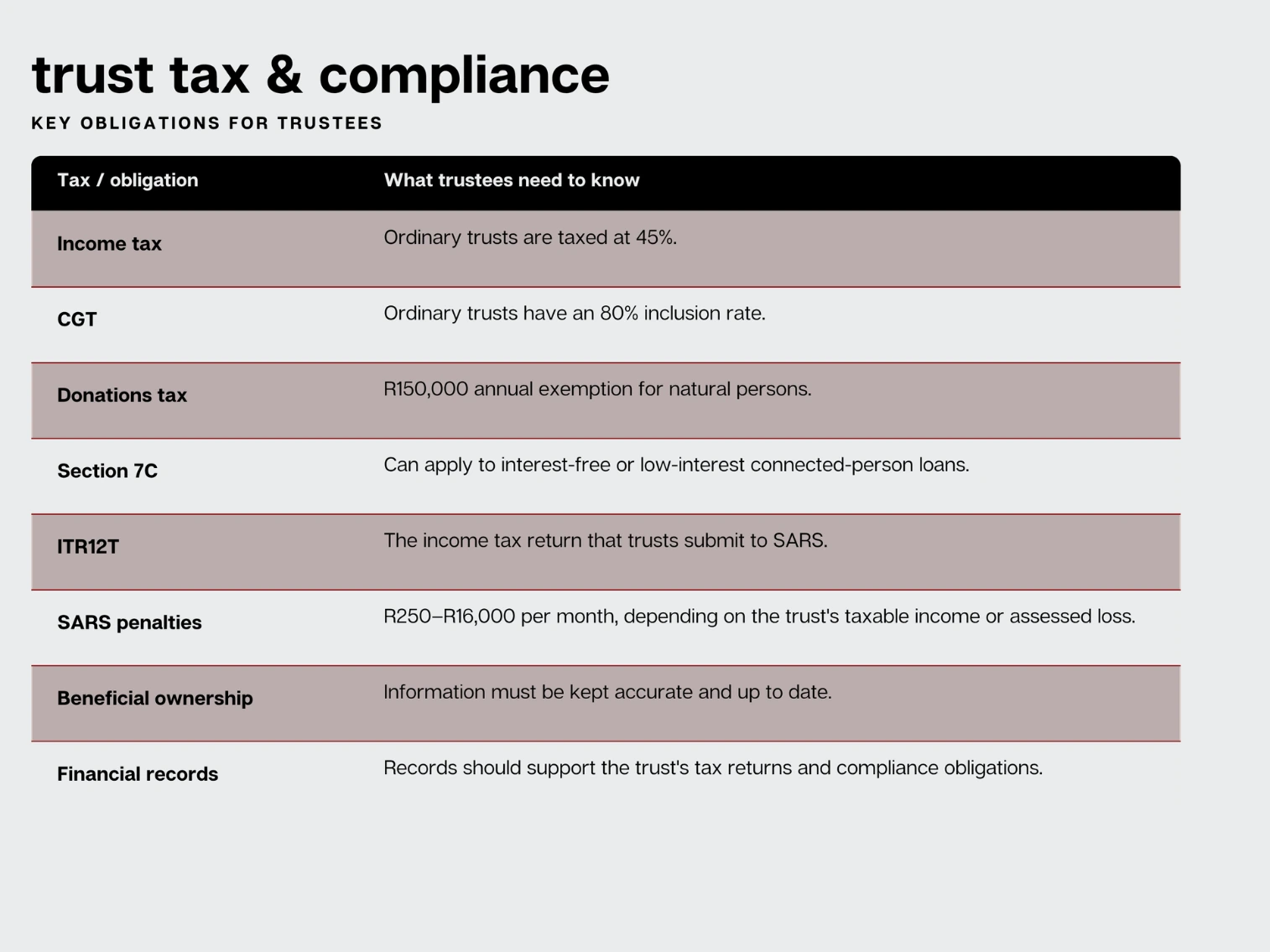
Income Tax
- Type A: A trust created solely for the benefit of a person or persons with a qualifying disability that prevents them from earning sufficient income for their maintenance or managing their own financial affairs.
- Type B: A testamentary trust created for relatives of the deceased, including a beneficiary under the age of 18, subject to the requirements in the Income Tax Act.
There is an important distinction when it comes to CGT: Type A special trusts can qualify for the annual CGT exclusion, while Type B special trusts receive the 40% inclusion rate but do not qualify for that annual exclusion.
Qualifying special trusts have a 40% inclusion rate, giving them a maximum effective CGT rate of 18%.
The rules contain specific exclusions and exemptions, so Section 7C needs to be considered in the context of the particular loan arrangement rather than treated as a blanket rule applying to every trust loan.
Learn more about SARS Tax Rates
Final Thoughts
And with SARS taking a much closer look at trust compliance, "the trust doesn't do anything" is no longer a good reason to ignore its obligations. A dormant or inactive trust can still have compliance requirements.
The good news is that trust compliance doesn't have to be complicated when the underlying records are in order.
If you're a trustee or trust founder, it's worth checking that your trust's tax returns, financial records, loan accounts, distributions and SARS information are all up to date. If the trust is no longer needed, don't simply leave it dormant — investigate the formal process for bringing its affairs to an end.
For XRA, this is where we can help. Accurate accounting records give trustees and their tax advisers a reliable starting point for managing the trust's tax and compliance obligations.
If you're unsure whether your trust's financial records are up to date, talk to XRA about getting the numbers in order before a compliance problem becomes an expensive one.
Disclaimer: This article is for informational purposes only and does not constitute professional advice. Trust and tax laws are complex and subject to change. Always consult a qualified professional for advice specific to your circumstances.
Frequently Asked Questions
A trust is a legal arrangement where assets are transferred to trustees who hold and manage them for the benefit of beneficiaries. Trusts are governed by the Trust Property Control Act and are used for estate planning, asset protection, and wealth transfer
Yes. All South African trusts must be registered for income tax with SARS and submit annual returns, regardless of whether they are active or dormant.
Ordinary trusts pay a flat income tax rate of 45% on income retained within the trust. Special trusts are taxed at individual rates.
Section 7C is an anti-avoidance rule that treats interest-free or low-interest loans from connected persons to trusts as donations for tax purposes. The deemed donation is calculated annually at the official interest rate on the outstanding loan balance.
From 4 May 2026, SARS began issuing automatic administrative penalties to non-compliant trusts. Penalties range from R250 to R16,000 per outstanding return and accumulate monthly until resolved
Disclaimer: This FAQ is for informational purposes only and does not constitute professional advice. Always consult a qualified professional for advice specific to your circumstances.
Contact Us
Not sure whether your trust is up to date with SARS? XRA can help you get your financial records and tax information organised so you know exactly where you stand.
Phone
Durban: 031 220 2815
Johannesburg: 010 141 1490